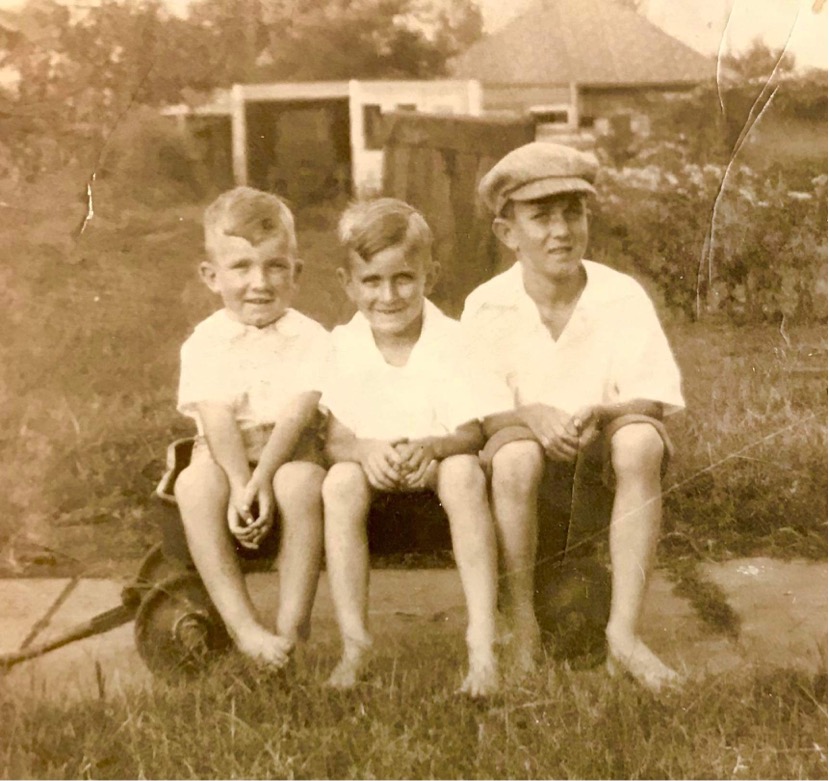
A few weeks ago, I was attending a meeting at the Alabama Baptist Children’s Homes. As I sat in the conference room, I noticed a historical timeline displayed on the wall. One entry in particular caught my attention. It marked the year the Children’s Home relocated from Evergreen, Alabama, to Troy. That might not seem particularly significant to most people. But to me, it was profoundly personal.
Just a few years after that relocation, my grandfather, Joseph Houston Paul, walked his three young sons approximately five miles from their home to the Alabama Baptist Children’s Home in Troy.
My grandfather was a veteran of World War I. During the war, he had been exposed to mustard gas, which our family believed contributed to the brain tumor he later developed. Facing a terminal illness and unable to provide for his family, he made what must have been one of the most heartbreaking decisions a father could ever make.
He entrusted his three boys to the care of the Children’s Home.
I have often wondered what that five-mile walk must have been like. What did he say to his sons along the way? Did they understand what was happening? Did he try to reassure them that everything would be all right, even as he faced the uncertainty of his own future?
After leaving his boys at the Home, my grandfather boarded a train bound for Memphis, where he sought medical treatment. He never returned. He died there from the brain tumor. And three little boys were left without their father.
The Providence of God
As I stood looking at that timeline a century later, a question came to mind:
What would have happened to those three little boys if the Alabama Baptist Children’s Home had not moved to Troy just a few years earlier?
I cannot answer that question. But I believe in the providence of God.
Somewhere along the way, a group of Baptist leaders made a decision to relocate the Children’s Home. I don’t know what discussions took place, what obstacles they faced, or what sacrifices were required to make that move possible.
But I know that when my grandparents desperately needed a place for their three sons, that place was there—just five miles from their home.
God’s providence did not prevent my grandfather’s illness or death. It did not spare those boys the grief of losing their father or the hardship of being separated from their mother.
But in the midst of that tragedy, God had provided a place where they could be cared for, loved, and given an opportunity for a future.
Sometimes we recognize God’s providence most clearly when we look backward.
Three Boys and Three Remarkable Lives
My father, Robert Paul, and his two brothers spent several years at the Children’s Home. Eventually, my grandmother remarried and was able to regain custody of her sons.
All three boys graduated from high school and went on to lives of remarkable service and accomplishment. All three served in the armed forces during WWII. The oldest brother made the Army his career, serving as a combat medic and becoming one of the original Airborne Rangers. The youngest brother became an engineer with NASA, contributing to one of the most extraordinary chapters of American scientific achievement.
My father graduated from high school and joined the Civilian Conservation Corps before entering the Army Air Corps during World War II. He served as a noncommissioned officer aboard a B-17 bomber in Europe. In March 1943, his aircraft was shot down over the Zuider Zee in Holland. He became a prisoner of war of the Germans and remained in captivity for more than two years, until his release from Stalag XVII-B in April 1945.
After the war, Dad returned home, completed his college education, and became a teacher. Over the years, he became a college professor and ultimately a university president.
Three little boys who had entered the Children’s Home under desperate circumstances went on to make significant contributions to their country, their communities, and their families.
But for me, the most important part of this story is not what they accomplished professionally.
It is what happened in their lives—and the lives that followed.
A Faith That Shaped Generations
During his years at the Alabama Baptist Children’s Home, my father became a follower of Jesus Christ. I don’t know all the details surrounding his conversion. I don’t know who shared the gospel with him or which adults most influenced his spiritual development. But I know the result. My father’s faith became a defining characteristic of his life.
He and my mother raised four children—two sons and two daughters—in church. For more than twenty years, Dad taught a men’s Sunday School class at First Baptist Church in Enterprise, Alabama.
Throughout his career in education, he invested in young people, particularly those who were marginalized or overlooked. He had a special concern for people who needed someone to believe in them.
Perhaps that compassion was shaped, at least in part, by his own childhood experience. A little boy who once needed someone to invest in him grew up to spend much of his life investing in others.
Dad lived long enough to see and affirm God’s call on my life to Christian ministry. He did not live long enough to see my brother answer that same call.
When I think about my father’s legacy, I don’t think first about his military service, his academic accomplishments, or his years as a university president. I think about a man who loved Jesus, loved his family, and faithfully invested his life in others.
And I think about the people at the Children’s Home who helped introduce him to the Savior he would follow for the rest of his life.
The Generational Ripple Effect
The influence of those years at the Children’s Home did not end with my father’s generation.
My cousin, Dr. Joe Paul, is the president of the University of Southern Mississippi. His father was the youngest of those three brothers.
When Joe learned that I would be sharing our family’s story with the board of directors of the Alabama Baptist Children’s Homes, he sent me a message that beautifully captured the significance of this ministry.
Joe wrote:
“The experience during the Great depression that my father and his two brothers had is parts tragic and heroic. Without the Alabama Baptist Children’s Home would they have made it out of poverty to live lives that gave their children, including Rob and me a chance to thrive? Likely not.
Your work not only helps children in the most dire need of love, support and a place to lay their head; but creates a generational ripple effect that changes the trajectory of families for generations to come.”
Joe’s words capture something that is easy to overlook when we evaluate the effectiveness of ministries like the Alabama Baptist Children’s Homes. Their impact cannot be measured simply by the number of children served, the nights of shelter provided, or even the immediate outcomes of their programs.
Those things matter enormously. But they don’t tell the whole story.
The true impact of investing in a child’s life may not be fully realized for generations.
The descendants of those three boys have served in education, scientific research, university leadership, accounting, Christian ministry, and countless other ways.
And beyond our own family, how many students were influenced by my father’s teaching? How many men were encouraged through his Sunday School ministry? How many people have been touched through the ministries of my brother and me? And the impact of my cousins…” Wow!
We cannot possibly know.
Joe calls it a generational ripple effect.
I call it a beautiful illustration of the providence of God.
The Generations We Will Never See
Psalm 78:4–7 challenges God’s people to tell the coming generations about His mighty works so that even children yet unborn might place their hope in Him. I love that expression: children yet unborn.
When my father came to faith in Christ at the Children’s Home, I had not yet been born. Neither had my siblings or cousins. Yet God was already at work through people whose names I may never know, shaping a spiritual legacy that would eventually reach us.
This is why the work of the Alabama Baptist Children’s Homes matters so much.
Of course, the value of a child is not determined by whether that child grows up to become a university president, a pastor, an engineer, or a professional success. Every child is precious because every child is created in the image of God.
But we should never underestimate what God can accomplish through the faithful investment of His people in the life of one child.
And that brings me back to the historical timeline in the conference room. A century ago, Baptist leaders made a decision to move the Children’s Home from Evergreen to Troy. They could not have known that a desperately ill father would soon walk his three boys five miles to their doorstep. They could not have known what those boys would become. They could not have known that one of those boys would raise two sons who would answer God’s call to Christian ministry.
And they certainly could not have known that a hundred years later, one of those sons would stand in that same ministry’s conference room, looking at a timeline and marveling at the providence of God. Yet here we are.
Every day, Christian ministries and their leaders make decisions about budgets, facilities, personnel, programs, and priorities. Some decisions seem routine. Others require great sacrifice and faith.
But we cannot possibly know how God may use those decisions in the lives of people we will never meet.
God’s providence often unfolds through the faithful decisions of people who will never live to see the full impact of their obedience.
That is a lesson for every church, every ministry, every Christian leader, and every believer who faithfully invests in the lives of others. We may not see the harvest of everything we plant. We may never know the full influence of the lives we touch. But our faithfulness matters.
A century ago, the Alabama Baptist Children’s Home invested in the lives of three little boys.
My cousin Joe and I are two of the ripples from that investment. And neither of us can begin to count how many others there are. Our siblings. Our cousins. Our children and grandchildren.
I am profoundly grateful for a ministry that was there when my family needed it most, and for the people whose faithfulness helped shape my father’s life.
We are all investing in generations we will never see.
And by God’s grace, the harvest is still coming in.

Thank you Rob for such a personal and inspiring article. If for no other reason your article instills the desire to help the Alabama Baptist Home for Children, even though there are many other reasons. I am grateful for the service provided to your grandfather and his three boys largely because of the positive impact you have had on so many, including me.
What a testimony of God’s providence! Oh my! That Ripple Effect just keeps on for generations yet to come. Thank you for sharing this..much love to you and Mel❤️